Last Updated: February 3, 2026
What is a Wildfire Temporary Refuge Building?
Wildfire Temporary Refuge Buildings (WTRBs) are designated, hardened structures intended to provide short-term life safety protection for occupants who are unable to evacuate safely during a rapidly advancing wildfire. These buildings are designed and prepared to withstand extreme radiant heat and ember intrusion for the limited duration of wildfire passage.
WTRBs are not evacuation shelters and are not intended for extended occupancy. Their purpose is to serve as a last-resort refuge when evacuation routes are compromised and immediate evacuation is no longer feasible. Use of a WTRB is authorized only under specific conditions and in accordance with established emergency procedures.
Key features typically include fire-resistant construction, protected ventilation or filtration systems, and minimal surrounding vegetation to reduce fuel load. Occupants are expected to remain inside until the immediate wildfire threat has passed and it is safe to relocate under the direction of first responders or Laboratory Emergency Services.
When to use WTRBs?
WTRBs shall be used only as a last-resort when safe evacuation is no longer possible due to rapidly advancing wildfire conditions. Occupants should enter a WTRB when evacuation routes are blocked or unsafe and there is an immediate threat to life.
WTRBs are intended for short-term refuge during wildfire passage and are not a substitute for early evacuation or a location for extended sheltering. Once conditions permit, occupants shall evacuate under the direction of incident command.
How will I be notified to relocate to a WTRB?
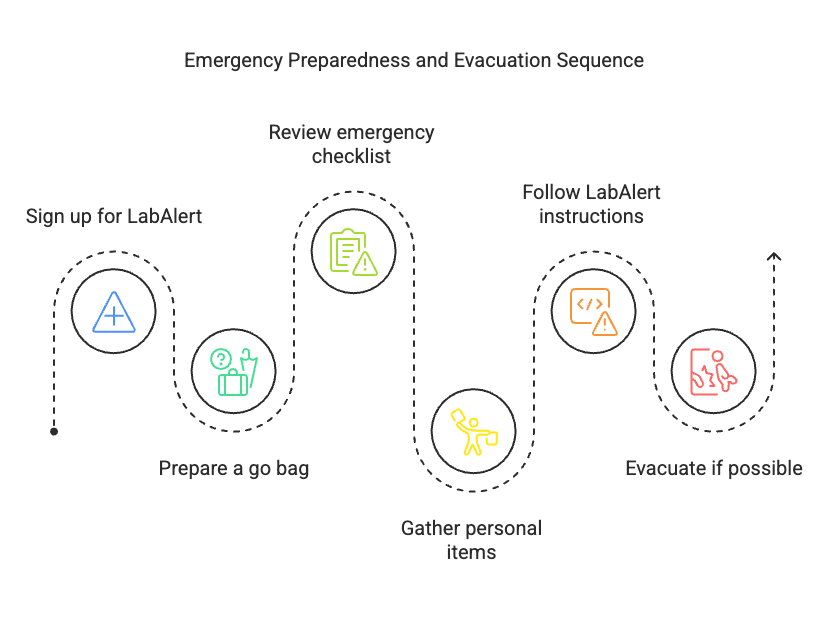
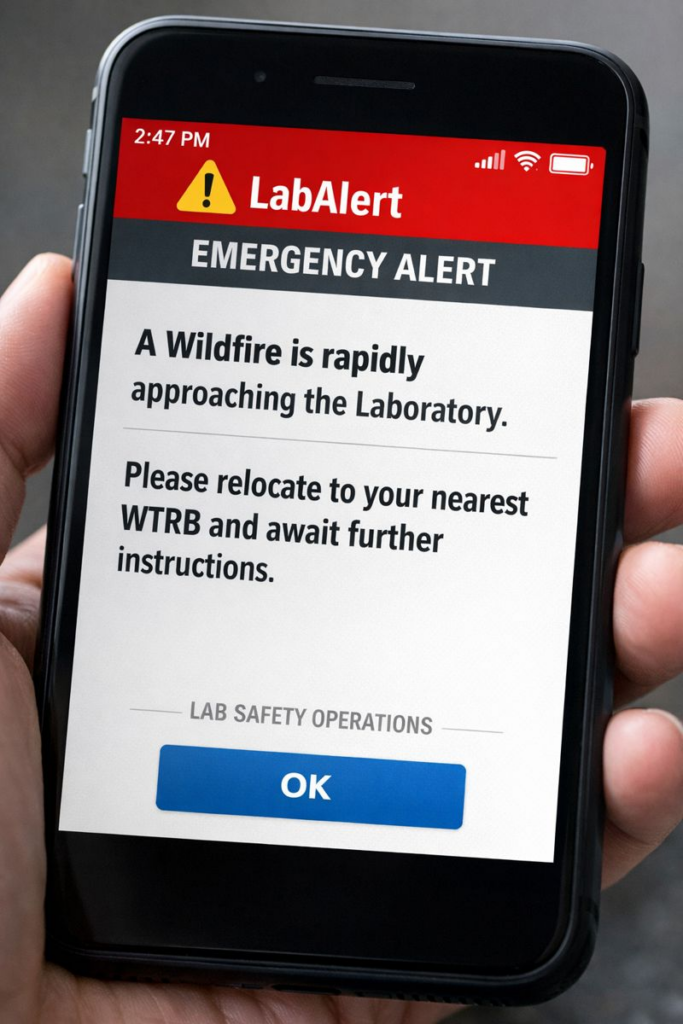
If it is determined that relocation to a WTRB is safer than evacuation, LBNL Emergency Services will issue a lab-wide LabAlert directing occupants to proceed to their nearest WTRB. Depending on wildfire location and conditions, the LabAlert may be targeted to specific protective action zones rather than the entire Laboratory. Upon receiving this message, notify all individuals in your immediate vicinity to ensure no one has missed the notification.
LabAlert Example
Where are the WTRBs?
There are two designated WTRBs in each protective action zone, for a total of twelve across the Laboratory. The map below identifies the locations of all WTRBs.

Wildfire Temporary Refuge Buildings by Zone
Zone 1
- Building 50 complex (50C not Included)
- Building 59
Zone 2
- Building 55
- Building 91
Zone 3
- Building 15
- Building 30
Zone 4
- Building 76
- Building 78
Zone 5
- Building 66
- Building 67
Zone 6
- Building 74
- Building 84
What should I do when I arrive at a WTRB?
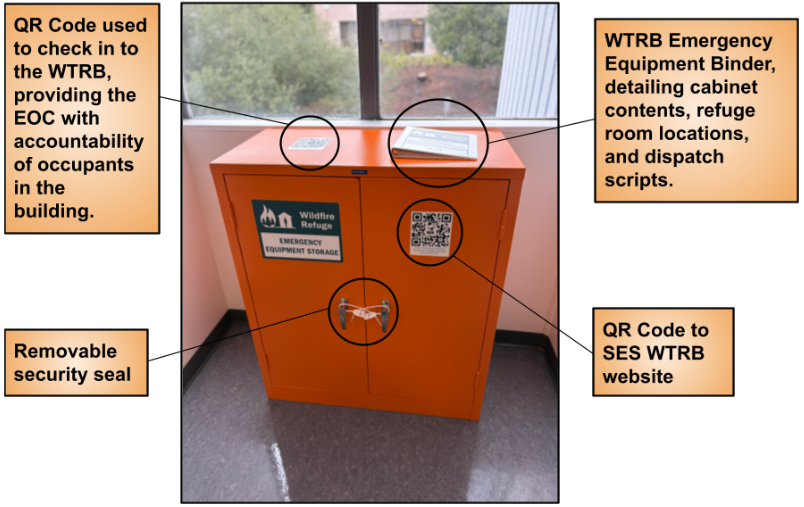
Once you arrive at the WTRB, locate the WTRB Emergency Supply Cabinet. Cabinets are typically placed in high-traffic common areas, and their locations are identified on Building Evacuation Maps posted near exits. Larger WTRBs may have multiple cabinets.
Use the QR code located on the top of the cabinet or on the back of the binder to check in for accountability. These check-ins are monitored in the LBNL Emergency Operations Center (EOC). Then open the binder and follow the instructions.
WTRB Emergency Supply Cabinet
How do I prepare for a wildfire incident at LBNL?
Ready
- Be prepared for any emergency by signing up for LabAlert, the Lab’s system of emergency communications. In the event of a nearby wildfire, messages from LabAlert will keep you informed.
- Prepare a go bag with items you would need in an emergency, such as walking shoes, spare glasses, and personal medication.
- Review the emergency checklist.
Set
Follow the instructions in the LabAlert. To prepare for evacuation, gather your phone, wallet, keys, badge, and go bag.
Go
Given enough time, evacuation is the preferred response. Limited exits from the Lab and traffic congestion on site and on neighboring streets can make it difficult to evacuate by personal vehicle. This may block access for first responders, creating unsafe conditions.
Wildfire Smoke and Air Quality
To learn more about resources the Lab has for dealing with wildfire smoke, including how to determine air quality and what steps you can take to protect yourself from the effects of wildfire smoke, visit wildfiresmoke.lbl.gov.
How Buildings are Evaluated for WTRB Use?
Buildings designated as WTRBs were selected by the Office of the Fire Marshal based on established wildfire protection standards, including the California Wildland-Urban Interface (WUI) Code, NFPA 1140, and DOE Handbook 1224. Selection focused on identifying structures capable of providing short-term refuge during a wildfire while minimizing occupant risk.
The following parameters were analyzed to determine suitability:
- Topographical Features: Assessing elevation, slope, and surrounding terrain that could influence wildfire behavior.
- Vegetation: Evaluating nearby plant fuels including vegetation density, species flammability, and the presence of ladder fuels or dry debris.
- Slope: Considering the angle of surrounding land (steepness), which affects fire spread and ember travel.
- Building Setback: Measuring distance from the structure to the edge of the predominant slope.
- Roofing Materials: Ensuring fire-resistant or non-combustible roofing to reduce ember vulnerability.
- Building Construction: Prioritizing structures with fire-resistant walls, windows, and doors.
- Fences and Attachments: Identifying combustible attachments that may increase wildfire risk.
- Fuel Modification: Considering any combustible fuels, heat sources, flame sources, or vehicle parking near the structure.
Buildings meeting these criteria were determined to provide a safe, short-term refuge when evacuation is not possible.
Please email emergencymanagement@lbl.gov with any questions or concerns.

